
What Would the World Miss if RMUS Didn't Exist?


Every company has a founding story, but not every founding story carries the kind of intellectual obsession that turns a casual business into a movement. For Rocky Mountain Unmanned Systems (RMUS) the origin wasn't simply a market opportunity spotted on a spreadsheet. It was a genuine, deep-seated fascination with how unmanned aerial systems could transform the way industries solve their most persistent and dangerous operational challenges.
When RMUS first launched, the company sold drones to both consumers and businesses. It didn't take long before the President of the company J.T. VonLunen started shifting his attention almost entirely towards the enterprise side. For J.T., there was something fundamentally more compelling about watching drones work and businesses use unmanned aerial systems to navigate challenges that had previously required significant human risk or enormous resource investment.
The industries were as varied as the problems themselves. Mining operations, search and rescue missions, tank inspections, every industry presented its own unique demands and its own definition of what ‘cost-effective’ meant in practice. Beyond selling hardware, it was about solving puzzles, and the puzzles never ran out.
According to J.T., “I get too into drones. Not really all the technology, but the problem solving behind how to use a drone to solve a certain task.”
This kind of relentless focus is often the engine behind the most enduring organizations. RMUS was built by people who never stopped asking the next question and never stopped caring whether the solution was actually working in the field.
Accelerating an Industry
RMUS became a connective force in the enterprise drone ecosystem, a company that didn't just sell solutions but actively worked to close the gap between what drone technology could theoretically do and what businesses could realistically adopt. By introducing hundreds of customers to drone manufacturers, RMUS helped surface real-world operational feedback that shaped better, more mission-specific products. This feedback loop separates consumer-grade technology from enterprise-grade precision, and RMUS helped build it.
Beyond product development, RMUS created extensive training materials specifically designed to ease the organizational adoption process. Adopting aerial robotics inside a large enterprise requires navigating internal approval processes, retraining personnel, and overcoming institutional skepticism. The resources RMUS developed turned potential roadblocks into manageable steps.
The Weight of Adversity

No honest account of what the world would lose without RMUS can avoid acknowledging what RMUS itself has had to endure to stay in it. In the President’s own words, “The last three years have been rough”. The company has had to navigate a fundamental transformation from shifting from a drone reseller model to that of a drone manufacturer. This is not a minor operational adjustment. It is the kind of change that touches every dimension of a business: supply chain, engineering capability, quality control, capital requirements, customer relationships, and organizational identity.
Transitioning from reselling to manufacturing is a leap that many companies attempt and far fewer survive. It demands a different kind of infrastructure, expertise, and a radically different relationship with risk. Yet RMUS is still here. The company is now entering the ‘what happened after’ chapter of that difficult story.
There is a quiet resilience in that framing, a straightforward acknowledgment that the hard part happened, that the organization absorbed it, and that it is still moving forward.
On Technology and the Limits of Automated Understanding
The firm draws a direct line between the early days of internet search engines and the current state of AI-generated summaries. RMUS believes both tools help, but neither replaces the depth of understanding that comes from direct human engagement. Artificial Intelligence can approximate a lot of things like general information about drone applications, operational best practices, and equipment specifications.
What it cannot do is replicate twelve-plus years of accumulated industry knowledge. The kind of nuanced understanding that only comes from having worked directly with hundreds of clients across dozens of industries. RMUS believes the phone is the best way to know them. That direct, human line of communication is precisely what RMUS provides in a form of value that does not compress well into automated summaries or algorithm-driven recommendations.
Perfecting the Physical

In the world of high-end drone manufacturing, the paradox of the most technically sophisticated components rarely being the hardest to get right is a paradox RMUS knows intimately. The months of painstaking effort, the detail that required the most iterations and caused the most frustration, was the plastic casing.
RMUS has invested significantly in developing advanced electrical components for drone autonomy. They built sophisticated systems that represent the cutting edge of what unmanned aerial vehicles can do in autonomous operational environments. Getting these systems to work was hard, getting them to work reliably was harder, but getting the exterior of the drone to look like a finished, professional, field-ready product proved to be the most stubbornly difficult challenge of all. To finalize the plastics, the structural casing and exterior components that give a drone its visual identity, the internal product must be nearly complete. Every adjustment to the electronics could require revisiting the casing, meaning the final visual product remained a moving target until very late in development.
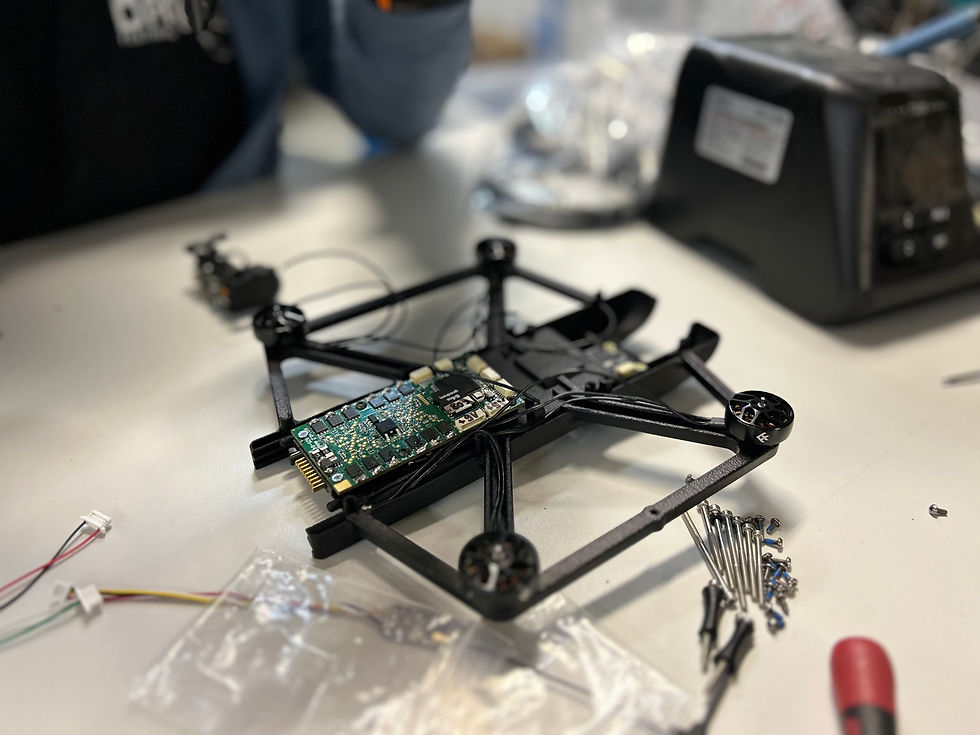
For RMUS, this matters as a statement of values. The company believes that even the most technically sophisticated product should look solid, intentional and not like a prototype. That attention to the complete product experience, not just the technical performance metrics, is a reflection of how RMUS approaches everything it builds.
There is an authentic relationship between the company and its clients as well. Over time, customers consistently
pronounced RMUS as the word ‘ARMUS’. Rather than correct it, RMUS leaned in, naming their tactical drone the ARMUS after the way most people naturally say the company's name.
A Weekly Reminder of What Drones Actually Do
If you asked RMUS for a single standout moment where a client realized how much money or risk the company had saved them, the honest answer is that there isn't one. There are too many. Across more than twelve years of operations, moments like these happen weekly. Drone deployments that came in dramatically under budget, mission-critical inspections completed without putting a single person in harm's way and many more challenges make up the firm’s history.
Drones are, at their core, extraordinarily effective tools for two things, saving time and keeping people out of harm's way. RMUS has spent over a decade making sure its customers understand that, and making sure they have the right equipment and training to actually deliver those outcomes in the field. The cumulative effect of thousands of these moments represents an enormous body of operational value that would be diminished without RMUS.
Dismantling the Myth of the Lone Founder

The media tends to attach a compelling but misleading narrative to entrepreneurial success as the lone visionary who builds something from nothing. RMUS exists because of its people, employees, vendors, and customers who have all played indispensable roles. This is a sincerely held belief, and one the RMUS team has made a personal mission to communicate.
The company belongs to the network of people who contributed to it over more than a decade. RMUS has built its reputation on those relationships and their core values of not taking shortcuts, not overselling, and not disappearing after the transaction closes.
Practical Wisdom for Those Just Starting Out
RMUS's answer to what it would tell someone just entering the field is deceptively simple, a drone is just a flying sensor. The advice is to not get distracted by the technology itself, to focus on what the drone can do, and find the problems where that capability creates meaningful value. This framing cuts through a great deal of industry noise and reflects a thinking orientation around the application layer and the real-world task that new entrants rarely have access to without a guide who has already made the expensive mistakes.
What Would the World Actually Miss?
What the world would miss without RMUS goes beyond just a firm or their products. The RMUS Global Network represents something that cannot be easily replicated. A community of the most experienced and most passionate professionals in the drone industry, connected through years of genuine collaboration make up who they are. It is built on operational trust that forms when an organization consistently delivers what it promises and prioritizes long-term client outcomes over short-term wins. The emphasis is on long-term connections rather than fast revenue. This goes beyond a cultural preference and becomes a competitive differentiation.
That is what the world will miss.
Not just a drone manufacturer. A reliable partner, a driving force in the industry, and proof that it is possible to establish something significant in a high-technology field while being fundamentally, resolutely human in how you conduct business.


