
What Would the World Miss If Inspired Flight Technologies Didn't Exist?


It's impressive to build a drone that can fly well. The true challenge is to create one that a critical operator can rely on, when the mission cannot fail.
In 2017, the founding team at Inspired Flight Technologies (IFT) started the company around a clear premise: it was becoming untenable for the United States to rely so heavily on foreign supply chains, especially those tied to adversarial nations, for a technology as critical as drone systems.
Since then, the company's mission has remained constant. Build drone systems domestically that operators could actually trust and build systems that are made for real missions in real environments. That intention has only grown more relevant as demand for reliable, domestically manufactured drone technology has accelerated across industries.
There are many ways to describe Inspire Flight Technologies, but at their core they are a company trying to prove that the United States could produce systems capable of meeting the demands that critical operators place on them every day.
Closing a Gap the Market Left Open

Inspired Flight Technologies recognized early on that there was a significant gap between what operators needed and what the domestic market could actually provide. The consequences of that gap meant that organizations doing important work, such as infrastructure inspection and utility operations, environmental research, and cultural preservation had limited options when it came to systems they could rely on and trust from a sourcing standpoint.
The approach has been to prove, through deployment after deployment, that U.S.-built systems can hold up under real-world demands. And the proof they provide moves the conversation in the industry from theoretical capability to demonstrated reliability. They design, assemble, and support NDAA-compliant drone platforms in the United States that are built for inspection, mapping, research, and public safety.
Without companies willing to do that work, the domestic market remains fragile, dependent on foreign production, and ultimately less trustworthy for the operators who need these systems the most.
What Happens When Things Go Wrong
No company building hardware in a fast-moving regulatory and supply chain environment escapes without challenges. For Inspired Flight Technologies, there has been no single defining failure, but there have been constant and significant pressures tied to operating in that environment.
One example illustrates how demanding this work can be. Replacing a single component, something as small as a battery or a motor, can require completely re-engineering the aircraft and putting it through extensive performance validation all over again. This industry demands such a high degree of discipline.
The company's response to these pressures has been to invest more deeply in engineering rigor, long-term planning, and transparent communication with partners. When issues arise, they are owned and addressed. That approach is what separates a company meaning to go beyond just selling a product.
Saving Time, Reducing Risk and Improving Decisions
Some of the clearest examples of what drone systems like these deliver come from the moments when clients realize how much the old way was costing them. Runway Inspections are a strong case in point. Traditionally, these inspections meant crews physically walking large sections of pavement, taking manual measurements, and working within tight time windows.
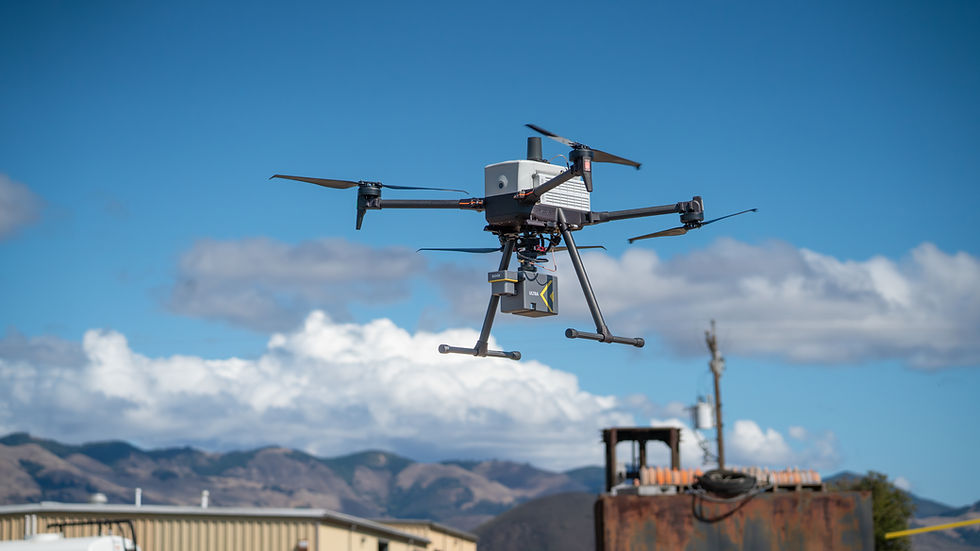
But in workflows like the Reading the Runway project, teams were able to replace traditional inspection with a complete, high-resolution dataset captured in a fraction of the time through the IF800 Tomcat paired with the Sentera 65R. This meant the aircraft was positioned to deliver engineering-grade pavement imagery in a single mission.
The immediate benefit is time savings, but the deeper value is in the quality of the decisions that follow. Instead of working from fragmented measurements, operators get a full picture of the surface condition, which means they can identify exactly where repairs are needed and avoid spending resources where they are not.
A similar shift has played out in utility operations, where rope pull installations that once required complex rigging, multiple crews, and dangerous access conditions can now be completed more efficiently and with significantly less risk to personnel. These are the moments where the conversation moves beyond cost savings and starts being about capability.
Changing The Conversation The Industry Was Having

One of the more significant contributions Inspired Flight Technologies has made is shifting how the drone industry evaluates what a system is worth. The conversation used to center almost entirely on what a drone could do in terms of speed, range, or flight time. Inspired Flight Technologies helped move it towards the reliability an operator can have on the system.
That shift means looking at how a drone is sourced, how it is validated, how it is manufactured, and whether it will perform consistently over time. As CEO Rick Stollmeyer has described it, “Our North Star is Whole System Excellence — interoperable aircraft, payloads, ground controllers, and peripherals that feel familiar and just work”
That philosophy is now becoming a standard part of how serious buyers evaluate drone solutions. Getting the industry to care about those things required someone to demonstrate that it mattered in the first place.
But Inspired Flight Technologies does not end at the philosophy. Behind every system they deliver is a process that most customers never see. Every component change requires validation. Every system must perform consistently before it reaches a customer. That testing discipline is what operators are actually buying when they choose a system from this company. Beyond the technical capabilities they recall that, particularly when it mattered most, the system performed as they had anticipated.
When the Mission Cannot Afford a Failure
Deployments where failure was just not an option provide some of the most striking illustrations of what Inspired Flight Technologies has created.
During a LiDAR expedition in the mountains of Peru, a team set out to search for pre-Incan ruins in a remote area of the Andes. Reaching the site required plane travel, ATV routes through riverbeds, equipment carried on horseback, and days spent at altitude in a clearing deep in the rainforest. When one of the two aircraft brought on the trip was confiscated at the border, the entire operation came down to a single drone flying in conditions it had never been fully tested in before.
As Tyler VanDenBerg, an engineer at Inspired Flight Technologies, reflected, “If the drone failed, we were all there for no reason.” It did not fail. That moment reinforced a philosophy that guides the company till date. Reliability is measured by taking into account how a system performs in unfavourable conditions when everything depends on it.
Proving Value Across Unexpected Applications

Not every application Inspired Flight Technologies has supported was an obvious fit from the start. Cultural and historical preservation is one example. When the opportunity came to support an aerial survey of the San Miguel Mission, it was not immediately clear how it fit the company's typical commercial use cases.
What this project demonstrated is that the potential of drone technology extends far beyond efficiency and cost savings. Deploying the IF800 Tomcat drone equipped with a Sony ILX-LR1 camera, a combination purpose-built for heavier payloads and stable flight in mission-critical environments, teams were able to capture detailed, high-resolution aerial data of a historic site with remarkable accuracy and zero physical intrusion. The resulting documentation represents a level of precision and completeness that traditional survey methods would have struggled to achieve.
That project is now used as a sales example precisely because it expands what people believe drone technology is for. It shows that these tools can preserve places and stories that communities care about, beyond just improving factors like speed of inspection.
What Would The World Miss?
A serious American company building drone systems for real work; dependable tools backed by engineering discipline, domestic manufacturing, and a deep understanding of how these systems are used in the field. This is what the world would miss.
As Rick puts it, “The work we do is both transformational and important… this is part of a once-in-a-generation opportunity, the reshoring of critical manufacturing to America.” It is more than just a business case; it is a stance on what the US needs to keep reliable, domestically managed capabilities in a field of technology that will only become more significant.


